Sunday, November 18, 2012

Gunning For Persuasion

If it wouldn't be for my new knowledge of fallacies I would sympathize with George Orwell's Shooting an Elephant. The secret Orwell uses for the attraction of his audiences are fallacies. With them he tells a simple story, but if analyzed, contains several types of fallacies that persuade the audience and make them sympathize with him. 

Right off the bat, or may I say gun, Orwell uses the unit fallacy in sentences such as "I was hated by large numbers of people" and "It was an immense crowd, two thousand at the least and growing every minute" to exaggerate for a more appealing story for the audience. Countless and estimated amount of people make it much more interesting than a set amount. Orwell manipulates his audience by making himself the victim in his murder. "To come all that way, rifle in hand, with two thousand people marching at my heels, and then to trail feebly away, having done nothing — no, that was impossible. The crowd would laugh at me." His use of the slippery slope fallacy helps him target the natives as bad guys if he would do the right thing leaving the audience to believe killing the elephant was his only choice from being humiliated. 

Overall his most used fallacies were tautology and the straw man fallacy. Orwell always repeated the natives' despised towards him and the British throughout the first paragraphs. This helps him disguise as the victim as all the natives mishandle and have no respect towards him even though it's the opposite as British Imperialism had India and its people oppressed. Finally his experience with the elephant allows him to avoid the topic of his country oppressing India and turn it around by making it seem that the Indians were oppressing him.

Orwell's clever use of fallacies permits him to become the victim in his story. It seems not only guns and words end lives, but also reputations.




Thursday, November 15, 2012

For The Best

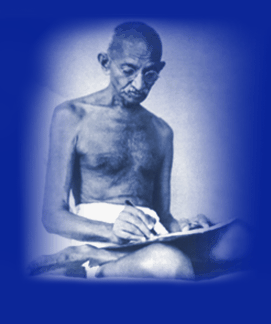
Thank You For Arguing has opened my eyes by showing me that rhetoric is truly found in every opinion and statement meant to persuade. Such influential people throughout history, like Gandhi, have used fallacies to get a point across and appeal to a greater audience. Even though fallacies are considered being fouls of rhetoric, it never fails to attract people form what is being proposed. I do not mean this in a negative way. I find that Gandhi's use of fallacies in London's Kingsley Hall was inspiring to all. Although hard to spot at first, further analysis of the text showed some examples of fallacies. 

The first fallacy I spotted was the straw man fallacy. Gandhi trails off his main topic to a side story about the village of Mysore. This showed how Gandhi uses a distraction to talk about what he knows better from his own experiences rather than his statements on how God is the right ruler. 

Tautology was also used mainly in his last paragraph. "Hence I gather that God is life, truth, light. He is love. He is the supreme Good. But He is no God who merely satisfies the intellect, if He ever does. God to be God must rule the heart and transform it." Gandhi repeats in different ways how God is ultimately good.

Finally hasty generalization can be found when Gandhi states, "whereas humble and mute acceptance of divine authority makes life's journey easier even as the acceptance of earthly rule makes life under it easier." He uses too few examples to interpret that following God's divine authority will make life easier. He expresses very few facts and examples to back that opinion up. 

Nevertheless Gandhi uses these fallacies well to persuade his audience about God being the right choice to follow. His opinions of Him appeals to the audience of how great it seems to be under His control. Knowing about fallacies, I am eager to read more speechs by famous historical figures to identify their choice of manipulation.


Monday, November 12, 2012

Lie To Me

Chapter sixteen and seventeen of Thank You For Arguing as introduced us to a skill that will be useful for socializing. We're steps closer to figuring out if someone is lying or if he/she really wants what is best for us. It isn't as sophisticated as reading people's expressions but much rather identifying if the persuader's need is the same as ours so we save ourselves from being manipulated. Though when being the persuader, it's a different story. Heinrichs also gives tips on how to avoid being caught. Always be in the middle of both extremes when proposing something. This will benefit you by seeming interested in your audiences needs and be trusted. It's easy to spot someone proposing the extremes giving off a radical position sending a signal to not be reckoned with. Everything seems to connect with each other. Using future tense you give your audience choices that benefit their needs. With this benefit, your audience will gain your trust and will appeal more easily to your persuasion.


In this scene from Family Guy we can see how both candidates appeal to their audience by saying what they want to hear and what they think they need. They are between extremes by not boring them with actual solutions and saying nothing but they are in between them, saying what the audience wants to hear. Of course this is satire however it proves Heinrichs point that giving the audience benefits and needs will make them more susceptible to being persuaded. 

Victory For Him or Them?

After months of hard work and campaigning, United States' President Barrack Obama has won his second term in office. His victory speech, other than inspiring, included much rhetoric that needed to be analyzed. To get the citizens the reassurance of the right decision Obama used fallacies for persuasion. His most obvious, and most successful for persuasion, fallacy was bringing an end to all their problems with hard work. This could work, though for now, you'd want the people's morale high. Despite his fallacies, Obama uses the past and future tense ably giving the people reassurance and something to expect in the coming years. It was great to see such a powerful speech being phrased by a great person.


Thursday, November 8, 2012

Facts, Fights, Fallacies, and Fun

Logic and rhetoric seem to of had enough of each other. Maybe not literally but it seems they are two different things. Logic tries to prove the right and wrong, giving the audience and the adversary straight answers. On the other hand, rhetoric gives the audience choices that are more susceptible for persuasion. Heinrichs makes this clear and directly introduces a new set of fallacies that run under these differences. These fallacies can distract a debate or turn into a fight.

Logical fallacies such as a person using facts against you instead of the topic, stating he can't be wrong because other people think so or the famous one because they have been believing it for a long time *cough* religion *cough* *cough*. Another fallacy Heinrichs goes into is the fallacy of power, "because the guy in charge wants it, this fallacy says, it must be good." (157). When you spot these fallacies you might end up fighting. To avoid getting stuck or using these fallacies it's good to use the present tense as it gives choices to the audience. "It's okay to use sermonizing, demonstrative rhetoric in a deliberative argument to get the audience on his side, but then the persuader should instantly switch to the future tense" (163). I mentioned in previous blogs about values and the present tense. It can be deadly to always be in the present as it will make your arguments harder to bring forward to audiences.

What your left with are discussions with asses. Literally. In this Family Guy scene the discussion is in present tense. The man is using logical fallacies, that work, to prove a point. Instead, the ass (sorry for my obscene words) is using his facts to attack the man instead of the topic and is also, what Heinrichs calls, "utter stupidity." The man is arguing against a fool.
Maybe, if the man used his rhetoric in future tense, the discussion would of not ended with so many NOs.


Sunday, November 4, 2012

Enough Brown Noising

We have kissed our audiences' behinds enough while learning about ethos and pathos to get them close to our traps. Once we have proven our point, it's time to attack. Logos, it's nice to see you again. Facts and knowledge are key for the audiences' understanding of the subject, and what you want to gain from it. Heinrichs shows us a new form of logos, the use of syllogisms and his partner in crime enthymemes. You don't want to make your audience feel stupid, thus enthymemes come into place when you utilize syllogisms but it removes the logical part of your argument. For its full potential, try to use it when talking about a subject the audience knows well so they'll get it.

Heinrichs is right when he states, "Marketers use a kind of syllogism all the time." (124). It can be seen in this famous Old Spice commercial. Basically the commercial is telling you, mostly towards women, that if your man uses Old Spice Body Wash, he can make your wishes come true. I mean who wouldn't want a body wash that lets you find tickets in oysters to things you love?

I found it impressive how logos can be used in many ways to get facts and knowledge can be expressed. To finish the job off just add some stories, comparisons and facts when using inductive logic. Its opposite, deductive logic, uses a commonplace to reach a conclusion. Men who smell good generally pick up girls more on average than men who don't shower. See. Now you want to shower because before you might of not been successful in picking up girls. You're welcome.